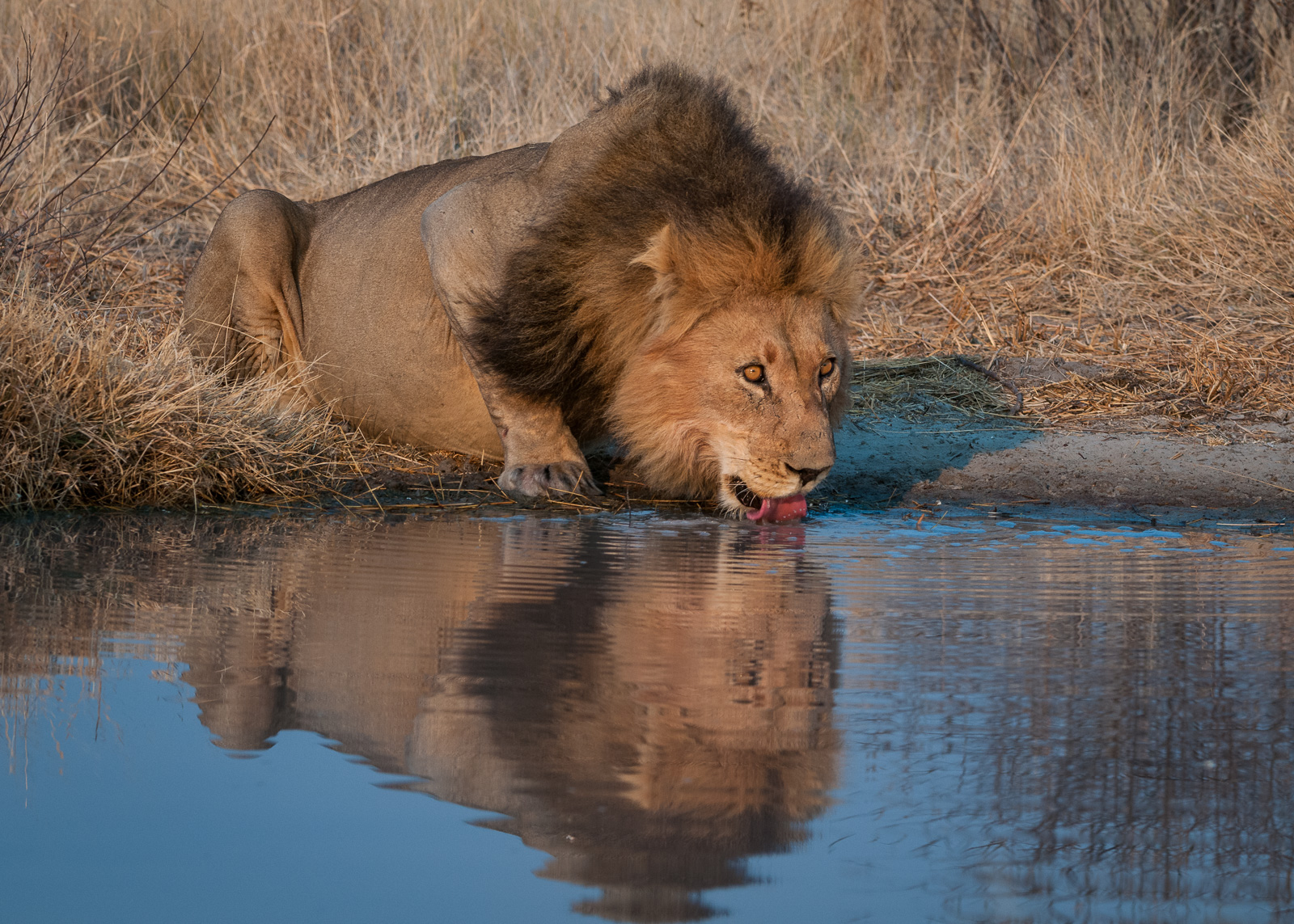
This water hole wasn’t too far from the camp I was staying at in the Kalahari Desert of Botswana. The first few days we had seen quite a few antelope species stopping for a drink, but then finally the big boys showed up. This guy filled up for quite awhile and as soon as he got up to leave, a second big-maned male walked up and took his spot. Nikon D300 with Nikkor 200-400mm lens (at 200mm) ISO 400, f/6.3 at 1/400th of a second.
Not that I have any complaints about our Eastern grays or American reds, but squirrels in other parts of the world can be pretty cool. This is the Malayan giant squirrel (also known as the black giant squirrel). S(he) was hanging around in a tree by my tent in Kaeng Krachan National Park in Thailand. They range throughout a good portion of Southeast Asia and live up to there name with a total body length — from nose to tip of tail — that can reach four feet. Nikon D500 with Nikkor 200-400mm lens (at 400mm) ISO 1600, f/4 at 1/1250th of a second.
A Facebook friend recently posted about Zanzibar and it took me back nearly 20 years to when I visited the island. This was my first real wildlife trip. I had been traveling on the mainland of Tanzania for three weeks, climbing Mount Kilimanjaro and then going on my very first safari. I ran out of film, of course, because that’s what you did on your first African safari before digital cameras. I remember buying some off-brand film from a local vendor in Stone Town in Zanzibar. The scan is bad (also about twenty years old) but I did what I could with the file to fix the strange color cast and grain and all that. As for the monkey, it’s an endangered Zanzibar red colobus monkey. They were quite habituated to people (one of the reasons they are endangered — along with the bigger problem of habitat loss). Nikon FM2 with Nikkor 85mm lens. No idea of the other camera settings.
Hummingbirds get some of the best names in nature. Like this here black-throated mango. This was one of the many hummingbirds that I was able to photograph at the Asa Wright Nature Center in the mountainous central region of Trinidad. Nikon D300 with Nikkor 200-400mm lens (at 240mm) ISO 500, f/10 at 1/250th of a second, two Nikon SB-900 flash units.
It’s rare that I post a shot where you can’t see the animal’s face. In this instance, however, I think it works. A mother bear and her cub loading up on veggies, getting ready for the coming hibernation. I like that the cub looks like a round ball of fur with those two little ears protruding from the top. This is another one from my trip a year ago to Lake Clark National Park in Alaska. Nikon D810 with Nikkor 70-200mm lens (at 105mm) ISO 800, f/5.6 at 1/1600th of a second.
Long-tailed macaques, also known as crab eating macaques, are fairly common monkeys in southeast Asia and they can often be spotted living amongst human populations. This guy looks to be out on some wild mountainside, but he was actually above a temple that sees quite a bit of daily foot traffic. He was calling across an open area to the macaques on the other side. Nikon D500 with Nikkor 200-400mm lens (at 200mm) ISO 800, f/4 at 1/640th of a second.
I met my first white squirrel a few winters back in Olney, Illinois. I actually met quite a few white squirrels that day, all living near the town center. Olney is one of several towns in the US and Canada claiming to be the “Home of the White Squirrel.” They are actually just a color morph of the common Eastern gray squirrel. Nikon D300 with Nikkor 200-400mm lens (at 400mm) ISO 800, f/4 at 1/125th of a second.
This rockhopper waddled right over to me as if he had a few questions before allowing me to photograph the colony. They certainly had the most attitude of the five species of penguin that I was fortunate to photograph in the Falkland Islands. This colony was on Saunders Island — the first of the four islands that I visited. Nikon D800 with Nikkor 17-35mm lens (at 17mm) ISO 800, f/5.6 at 1/400th of a second.
A pair of crested ducks take a moment to relax and preen themselves after a good swim. This was in the town harbor of Puerto Natales where we stopped for lunch on our way to Torres Del Paine in Chile. Of course, I didn’t really sit for lunch as there were many ducks and geese and other birds around which took precedent. Nikon D500 with Nikkor 200-400mm lens (at 200mm) ISO 100, f/4 at 1/640th of a second.
A rare shot with no animal present, but make no mistake, there were pumas hidden in the grass down by that lake. We got to this location at first light to search for a mother and her three cubs that had been spotted in the area the day before. It started to rain, and our tracker wasn’t quite sure of the pumas’ exact location so we had to stay put in our van until he came up with a plan of action. I couldn’t let all that great light go to waste, so I got out and took a bunch of landscape shots. In front of me was Lake Sarmiento and the typical scrub brush of Torres Del Paine called mata negra (black bush) and behind was a spectacular rainbow, pictured below. Top shot: Nikon D810 with Nikkor 17-35mm lens (at 17mm) ISO 200, f/18 at 1/3rd of a second. Bottom shot: Nikon D810 with Nikkor 17-35mm lens (at 17mm) ISO 200, f/18 at .5 seconds
We use cookies to enhance your experience while using our website. If you are using our Services via a browser you can restrict, block or remove cookies through your web browser settings. We also use content and scripts from third parties that may use tracking technologies. You can selectively provide your consent below to allow such third party embeds. For complete information about the cookies we use, data we collect and how we process them, please check our Privacy Policy