Seemed an appropriate time of year to post this Halloween pennant dragonfly. In Florida, these guys can be found year round. This one was photographed in Everglades National Park a few years back. Nikon D800 with Nikkor 200-400mm lens (at 400mm) ISO 800, f/4 at 1/800th of a second
This pronghorn was quite relaxed as the sun was setting behind him. He allowed me a fairly close approach and I was able to get down on the ground for this photo. Always nice to capture the rim light on larger, iconic mammals. Nikon D810 with Nikkor 200-400mm lens (at 350mm) ISO 800, f/4 at 1/8000th of a second
There are three scrub jays in the United States, the Western scrub jay, the Florida scrub jay and the island scrub jay. Both the Florida and the Island inhabit a very small region of the country (especially the island scrub jay which exists only on the island of Santa Cruz in the Channel Islands — the smallest range of any bird in the US). I’ve yet to be to Santa Cruz Island so that scrub jay will have to wait for another day. The Western scrub jay above was photographed in the Santa Monica Mountains last year, while the Florida scrub jay (which also has a very small range limited to central Florida) was photographed on Merritt Island. The Florida scrub jay is a threatened species due to loss of its scrub habitat and they are closely monitored, as evidenced by the band on the bird’s lower leg. Top Photo — Nikon D800 with Nikkor 200-400mm lens (at 400mm) ISO 800, f/4 at 1/320th of a second
Bottom Photo — Nikon D300 with Nikkor 200-400mm lens (at 400mm) ISO 400, f/5.6 at 1/1600th of a second
Giant river otters live up to their name. They are big. About six feet in length. I was floating down a river in the Pantanal of Brazil when I saw these three enjoying the early morning sun. Nikon D300 with Nikkor 200-400mm lens (at 280mm) ISO 1600, f/5.6 at 1/640th of a second
I took this one a few years back at the Vince Shute Wildlife Sanctuary in Orr, Minnesota. A cinnamon colored black bear cub calling to mom while climbing down from a tree. As always, click for a larger view. Nikon D800 with Nikkor 200-400mm lens (at 310mm) ISO 500, f/4 at 1/500th of a second
As far as monkeys go, the white capuchin is not one of the prettiest. But then again, it is a monkey, and by virtue of that alone, I think the white faced capuchin is a fine beast. I got a nice close look at the baldish, yet hairy-ish face on this one late one afternoon in Drake Bay, Costa Rica. Nikon D800 with Nikkor 200-400mm lens (at 400mm) ISO 1600, f/4 at 1/320th of a second
Here’s one for the entomology fans — a giant red-winged grasshopper. I don’t know much about these guys other than they are big. Up to seven inches in length. This one was hiding in the leaf litter on a trail through Corcovado National Park in Costa Rica. For close-ups of larger small things like this guy, I like to use my 200-400mm lens because of its ability to focus at close range. Nikon D800 with Nikkor 200-400mm lens (at 400mm) ISO 1600, f/4 at 1/125th of a second
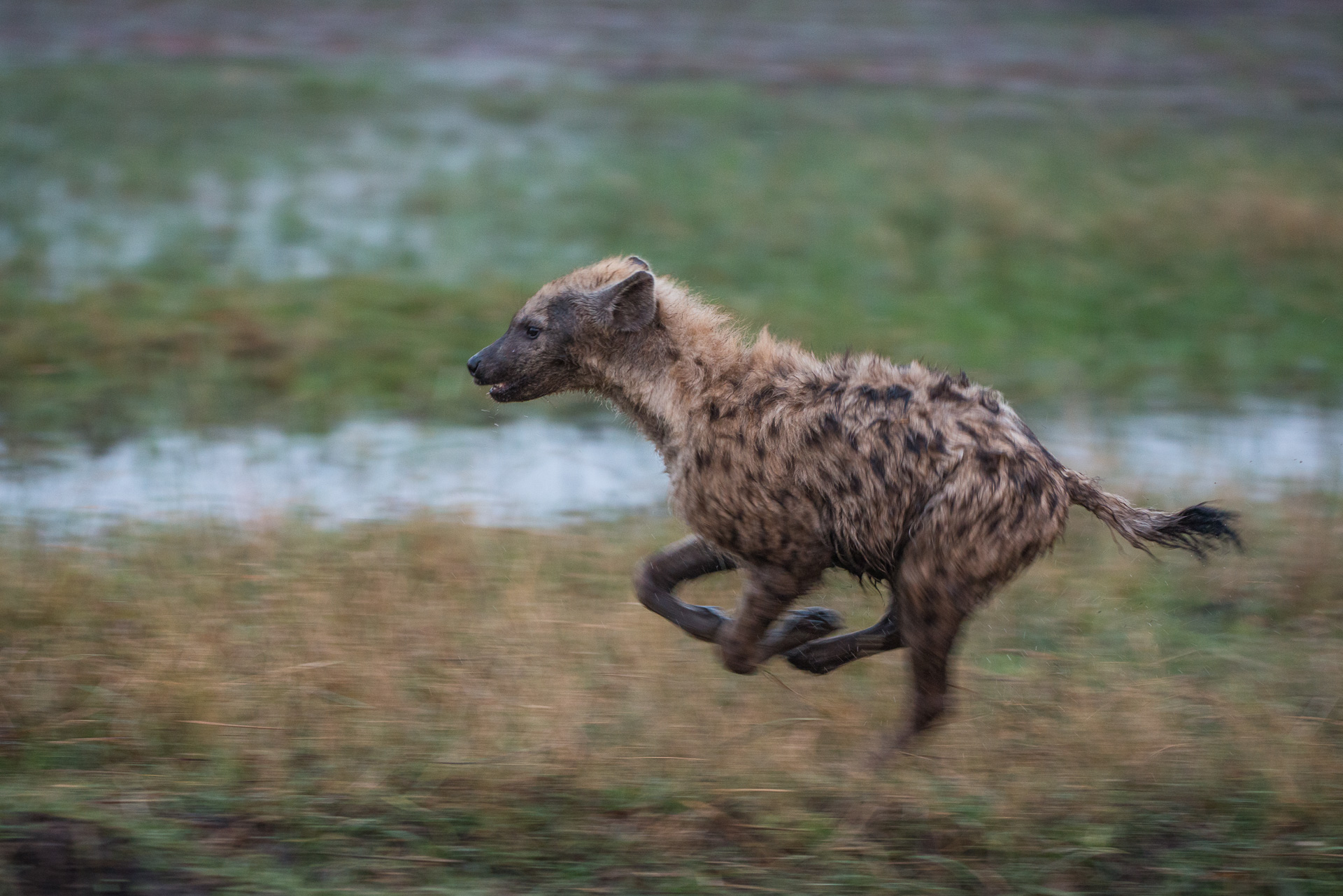
This one was taken early in the morning in northern Botswana. Several spotted hyena were romping around in a flooded plain chasing after each other and apparently having a good old time — unusual behavior for the ordinarily laid back hyena. There wasn’t much light so most of my pictures from this session were motion-blurred panning shots. For this one I had enough light (but still had to pan with the hyena) to freeze the head and torso. Nikon D800 with Nikkor 200-400mm lens (at 240mm) ISO 1600, f/4 at 1/160th of a second
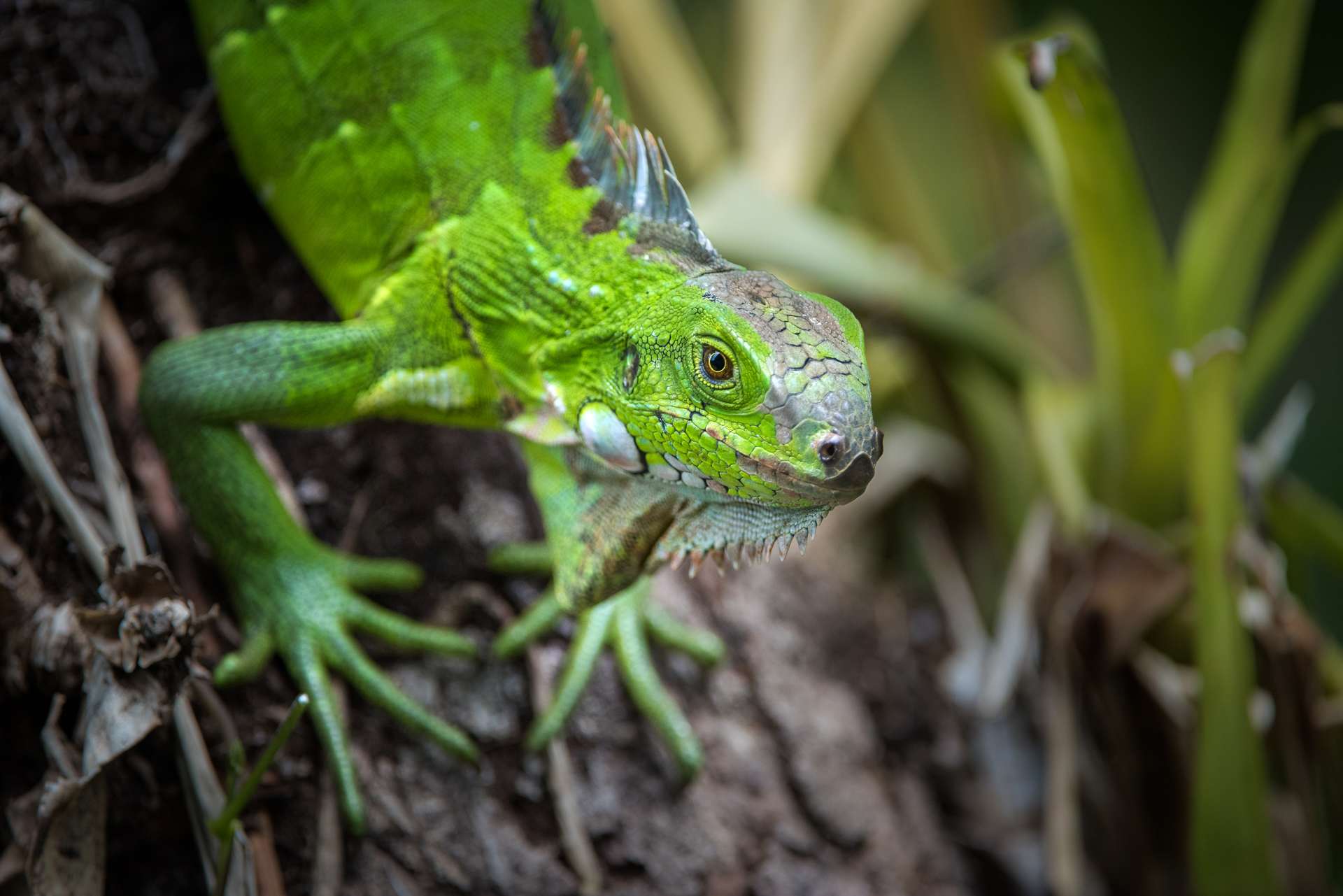
Depending upon location, green iguanas can come in many colors, including orange, blue and even pink. This one, however, properly lives up to the name. It was photographed in Trinidad at the Asa Wright Nature Center. Green iguanas are a widely distributed species and they can be found as far south as southern Brazil and Paraguay, all the way up to the Florida keys. Nikon D810 with Nikkor 200-400mm lens (at 400mm) ISO 800, f/4 at 1/2000th of a second
This is a red-bellied lemur, photographed in Ranomafana National Park in the east central region of Madagascar. These lemurs are considered vulnerable due to diminishing habitat (as are all lemurs). In this case, it’s mostly due to slash and burn farming. The male and female of the species are fairly similar in appearance, although the male has a more pronounced teardrop-shaped patch of white beneath the eyes. Nikon D200 with Nikkor 80-200mm lens (at 200mm) ISO 200, f/5.6 at 1/60th of a second, Nikon SB-800 flash
We use cookies to enhance your experience while using our website. If you are using our Services via a browser you can restrict, block or remove cookies through your web browser settings. We also use content and scripts from third parties that may use tracking technologies. You can selectively provide your consent below to allow such third party embeds. For complete information about the cookies we use, data we collect and how we process them, please check our Privacy Policy