I’m not sure what species of chameleon this is, I just know that it wasn’t looking like it was too thrilled with the way its day was going. This one was taken at a chameleon farm in central Madagascar. Half the world’s chameleons live in Madagascar — 59 species of which live nowhere else on earth. Nikon D200 with Nikkor 80-200mm lens (200mm) ISO 100, f/22 at 1/60th of a second, Canon 500D close up filter, Nikon SB-800 flash
Grazing zebras are a common sight on the savanna. This small herd was enjoying a late breakfast when we came upon them backlit by the rising sun. Nikon D700 with Nikkor 70-200mm lens (at 95mm) ISO 400, f/22 at 1/60th of a second
I recently posted a photo of the dwarf mongoose. This guy is a different species, called the slender mongoose. He/she was also photographed on our recent trip to Botswana. Nikon D800 with Nikkor 200-400mm lens (at 400mm) ISO 400, f/4 at 1/1250th of a second
I saw several of these tiny rain frogs while hiking at night in the Ecuadorian cloud forest. On this particular evening, a steady mist was falling, making all the frogs quite content. Nikon D700 with Nikkor 105mm macro lens, ISO 200, f/14 at 1/60th of a second, two Nikon SB-900 flash units
This one is from Kibale National Park in Uganda. I saw thirteen different species of primates on that trip, including this red-tailed monkey. Wish I had a little bit better lighting conditions, but I did the best I could given the situation and the bright sky in the background. I don’t know much about these monkeys, other than the fact that they have red tails and they were featured in the popular BBC youtube series, Funny Talking Animals — Walk on he Wild Side(click here). Nikon D300 with Nikkor 200-400mm lens (at 400mm), ISO 800, f/4 at 1/160th of a second
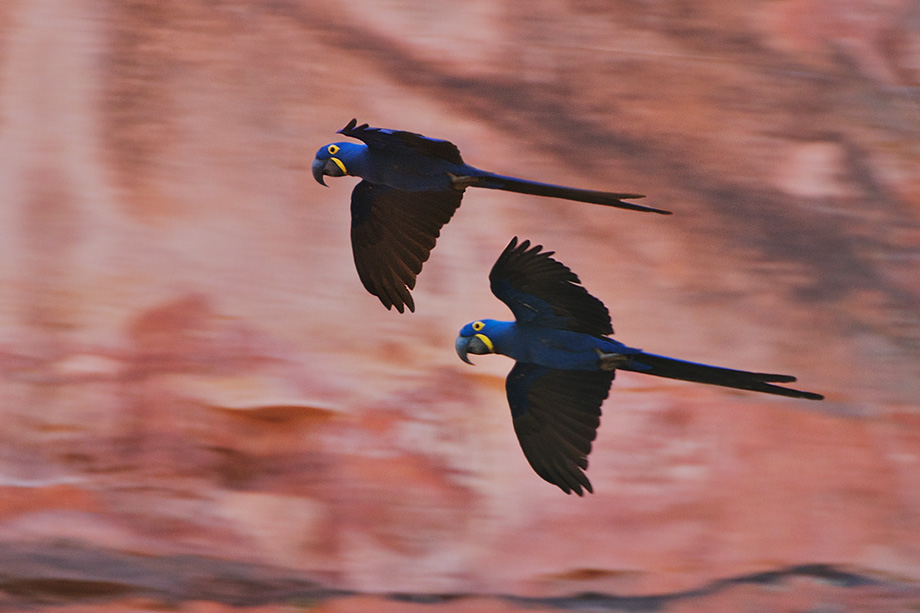
When I went to Brazil two years ago, one of the main species that I wanted to photograph — and expected to photograph — were hyacinth macaws. As it turned out, I only saw about four of them, and not until they were flying away. These are two of the four. Beautiful birds — brought to life in the Disney movie “Rio.” Nikon D300 with Nikkor 200-400mm lens and Nikon TC-E14 II teleconverter (for a total of 550mm/825mm with crop factor) ISO 400, f/5.6 at 1/200th of a second
It was late in the day when I captured this photo of a giraffe running across the savanna in Botswana. Panning my camera with the giraffe while using a slower shutter speed created the nice motion blurred effect of the landscape. Seeing giraffes run is always one of my favorite things to watch while on safari — both awkward and graceful at the same time. It almost appears as if they are running in slow motion. Nikon D700 with Nikkor 70-200mm lens (at 200mm) ISO 400, f/5.6 at 1/30th of a second
Here’s another marine iguana from the Galapagos Islands. This photo was taken on La Fe, a tiny little place that we visited as a day trip while staying at a camp on the nearby, larger island of Santa Cruz. This was a great little excursion, as we had the island completely to ourselves. As I mentioned in an earlier post — although marine iguanas are present on virtually every island in the Galapagos archipelago, they have evolved slightly differently on each. On La Fe, they definitely had more of an orange appearance to their skin. This one looks like it’s the only individual around, but they were virtually all over the place, draped lazily over the volcanic rocks that fringed the island. Nikon D800 with Nikkor 17-35mm lens (at 17mm) ISO 400, f/10 at 1/1000th of a second
The Verreaux’s eagle owl is the one owl that I’ve seen the most of in my six trips to Africa. That being said, it’s still a fairly rare sighting. It’s the third heaviest owl in the world and fourth longest (just behind the great gray owl). I’ve always liked the pink eyelids that make the Verreaux’s eagle owl look like it’s wearing colorful eye shadow. Nikon D800 with Nikkor 200-400mm lens (at 400mm) ISO 800, f/4 at 1/80th of a second
Chimpanzees can be difficult to photograph in the wild. They spend most of their time high in the canopy set against the bright white backdrop of the sky. After several days trying to get decent shots, I finally came upon a troop closer to the ground. This female saw me through the opening in the tree before scampering off to higher ground. Nikon D300 with Nikkor 200-400mm lens (at 220mm) ISO 800, f/4 at 1/100th of a second
We use cookies to enhance your experience while using our website. If you are using our Services via a browser you can restrict, block or remove cookies through your web browser settings. We also use content and scripts from third parties that may use tracking technologies. You can selectively provide your consent below to allow such third party embeds. For complete information about the cookies we use, data we collect and how we process them, please check our Privacy Policy