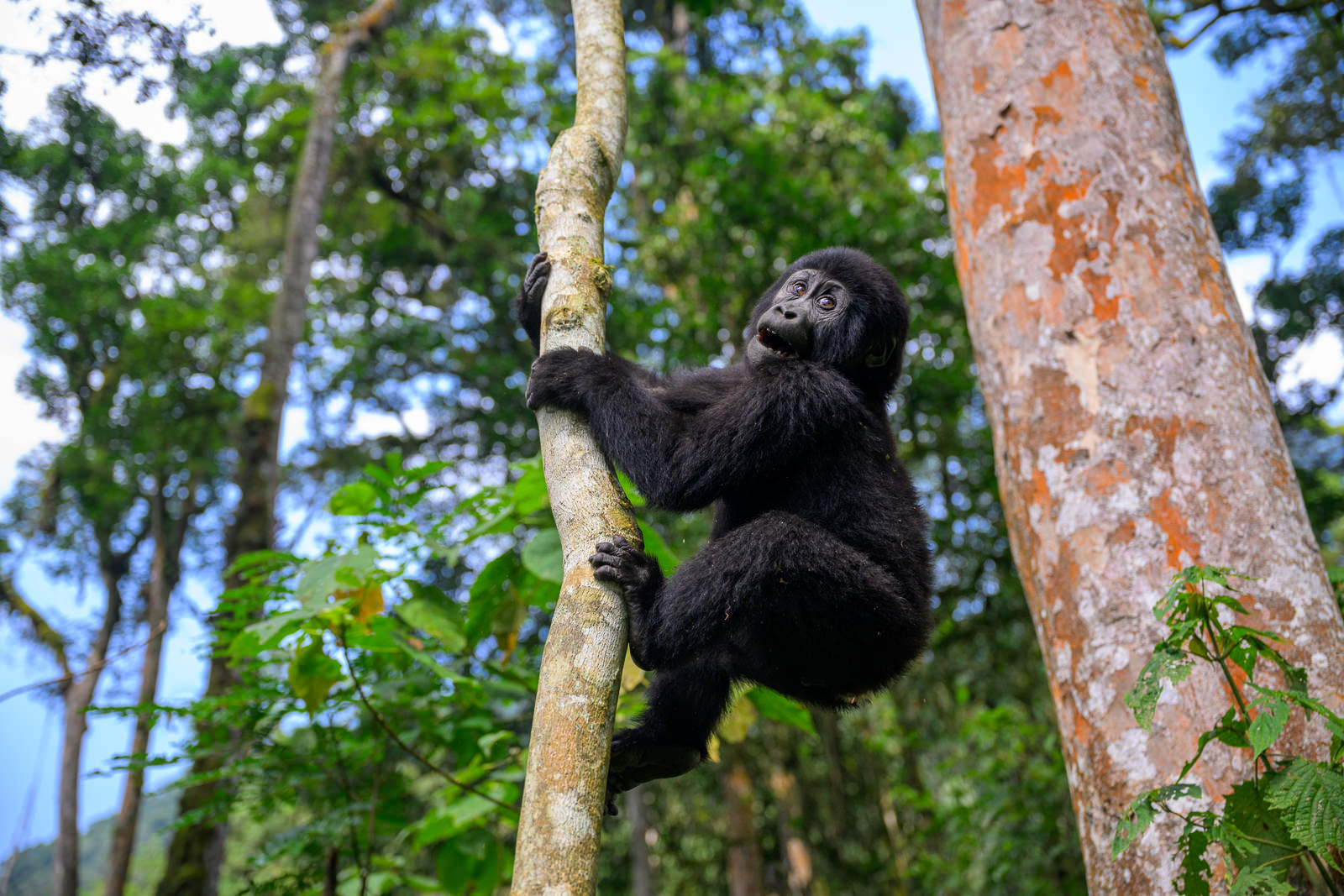
When speaking of humans, the term infant usually means up to one year old, but with mountain gorillas, an infant is classified as any individual up to there and half years old. After that they are classified as juveniles until the age of six. We saw this infant on our August trip to Uganda. He was playing on the ground only a few feet away when he suddenly started racing up that tree. Nikon Z8 with Nikkor 24-70mm lens (at 39mm) ISO 900, f/2.8 at 1/640th of a second.
Getting up from the ground is an arduous task for an adult male giraffe, which can weigh more than 3,000 pounds and stand nearly 18 feet tall. To rise, a giraffe must first straighten its hind legs, then push up with its front legs, shifting its enormous weight in a carefully coordinated sequence. Because getting up takes time and leaves them vulnerable to predators, giraffes generally spend relatively little time lying down. Nikon Z8 with Nikkor 180-600mm lens, 4K at 120fps.
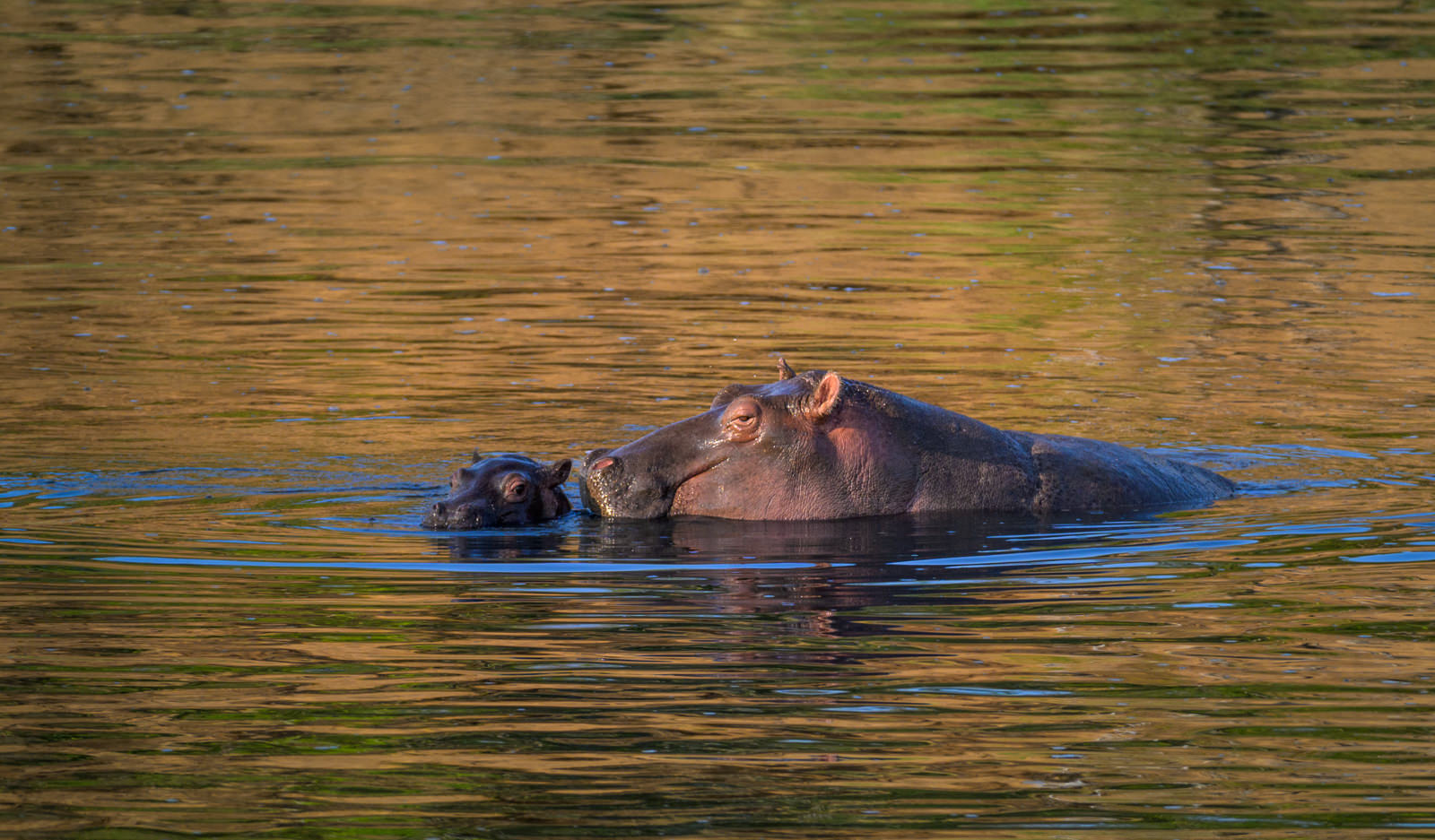
Hippo calves are born in or near the water and can nurse both on land and underwater, closing their nostrils and ears while submerged. For the first several months, a calf stays very close to its mother, often resting against her or using her body for protection from other hippos and potential predators. Nikon Z8 with Nikkor 180-600mm lens (at 600mm) ISO 360, f/6.3 at 1/640th of a second.
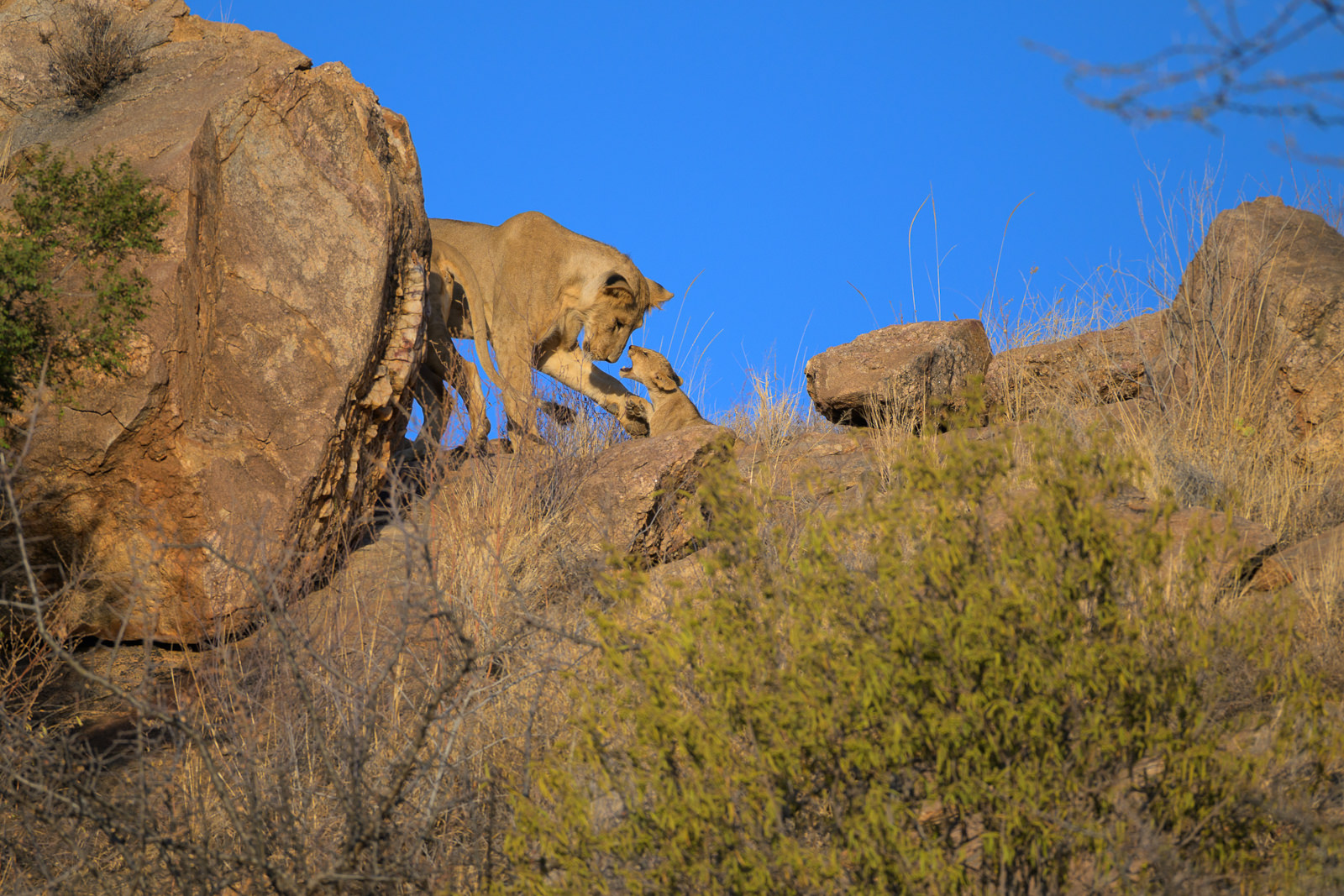
Nice little interaction here of a mother lion and one of her cubs. There were four adult females up there behind the boulder with three cubs. Eventually the adults headed off to hunt a baby baboon that found itself in a bad situation. More on that in a future post. Nikon Z8 with Nikkor 180-600mm lens (at 600mm) ISO 360, f/6.3 at 1/1000th of a second.
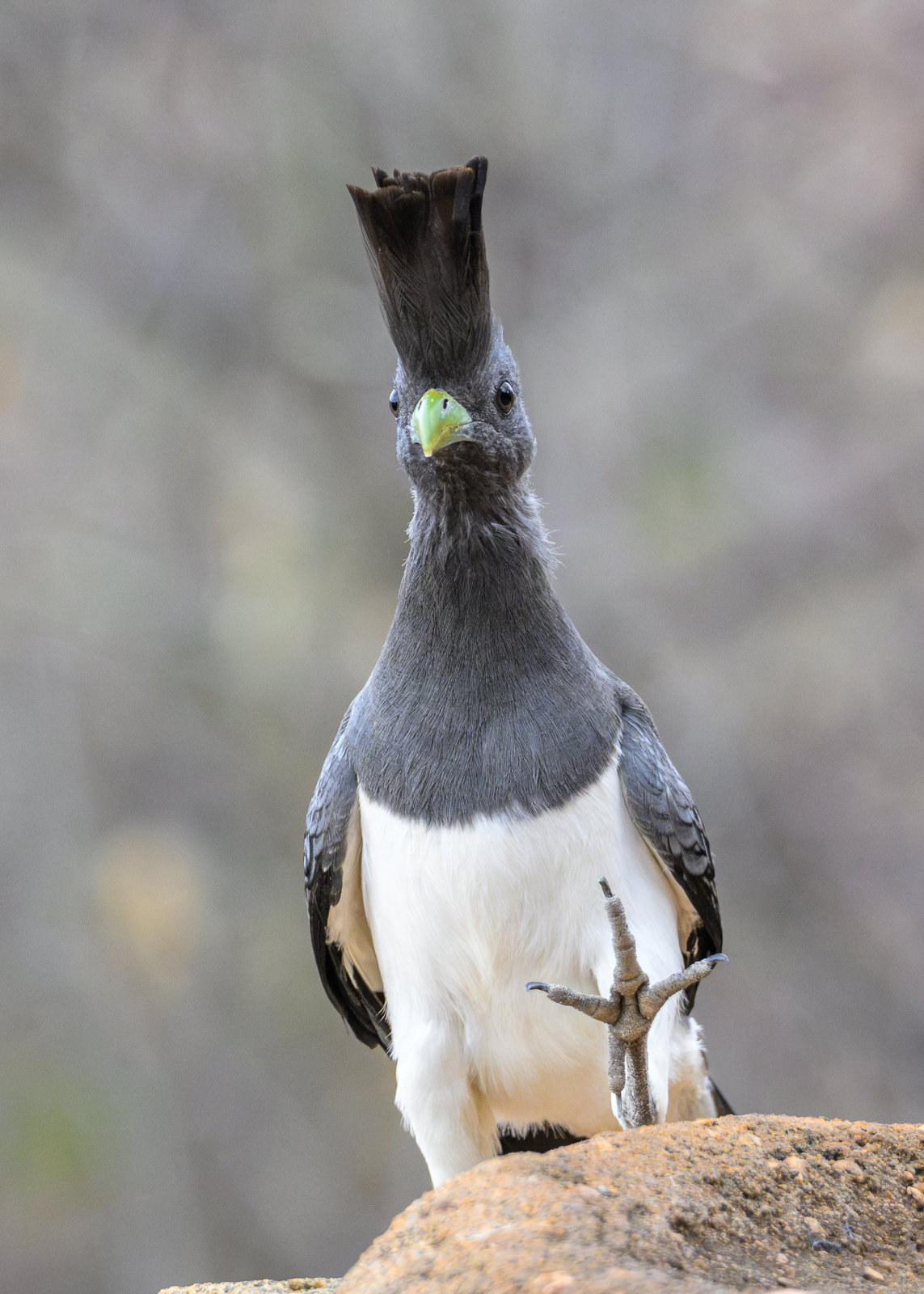
The white-bellied go-away bird gets its name from its alarm call. They say it sounds like the bird is screaming “go away.” Not sure I exactly agree with “they” on this one, but perhaps the go-away birds I’ve encountered haven’t been alarmed enough. This one was hanging around our camp in northern Kenya, flying in to a birdbath that was strategically placed for optimal viewing. These guys are quite large — about the size of a crow. Nikon Z8 with Nikkor 180-600mm lens (at 380mm) ISO 3200, f/6.3 at 1/2500th of a second.
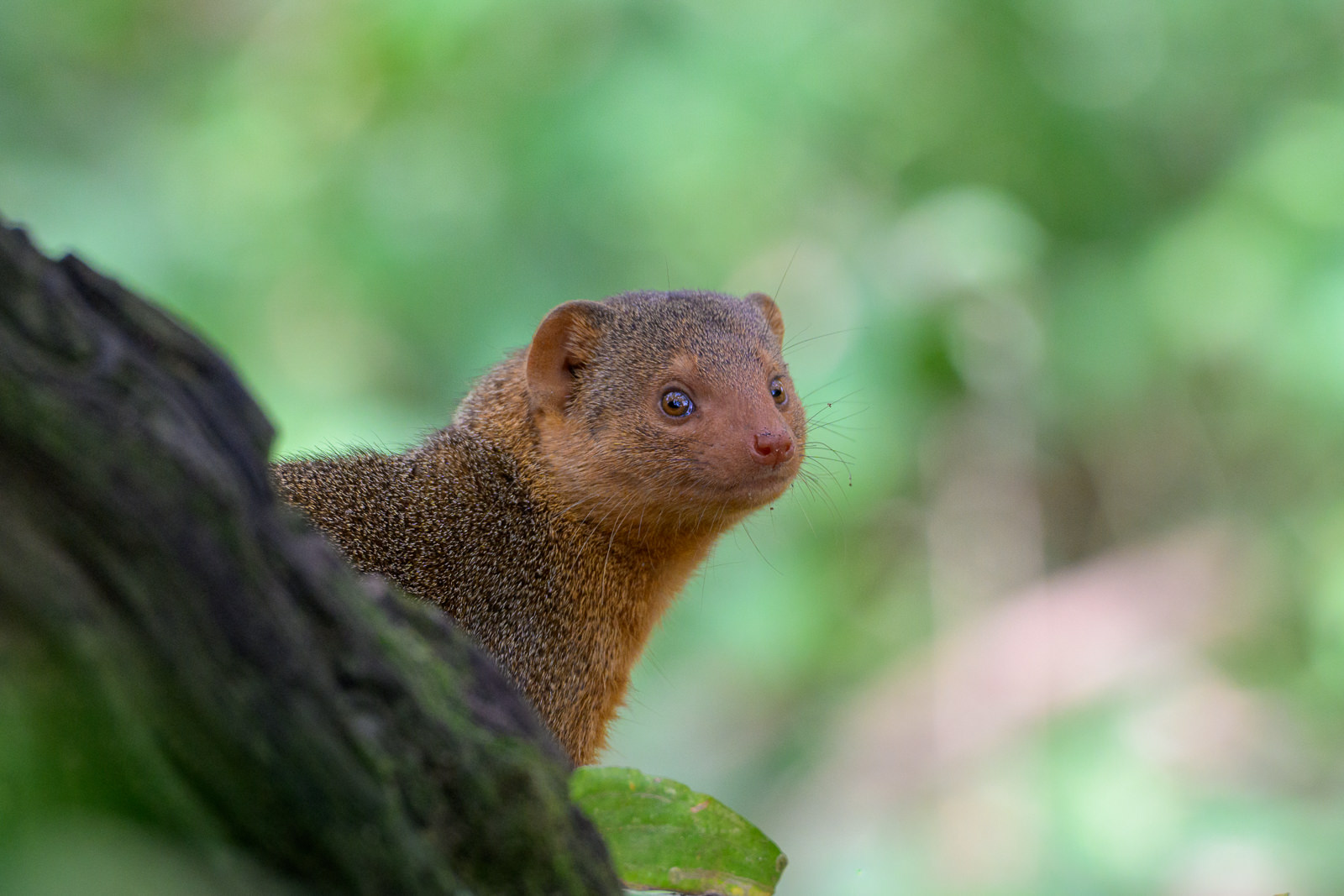
We see several species of mongooses on our tours to Africa. This is the dwarf mongoose — the one we most commonly see around the tented areas of the camps we stay at. I always have my eye out — and camera in hand — when walking to and from lunch in the middle of the day. Nikon Z8 with Nikkor 180-600mm lens (at 600mm) ISO 2000, f/6.3 at 1/200th of a second.
A very quick video of a Kirk’s dik-dik having a hard time getting rid of a fly. Add that to the lurking lions and leopards we saw nearby and it’s tough out there on the savanna for a dik-dik. Nikon Z8 with Nikkor 180-600mm lens, 120fps, 4K.
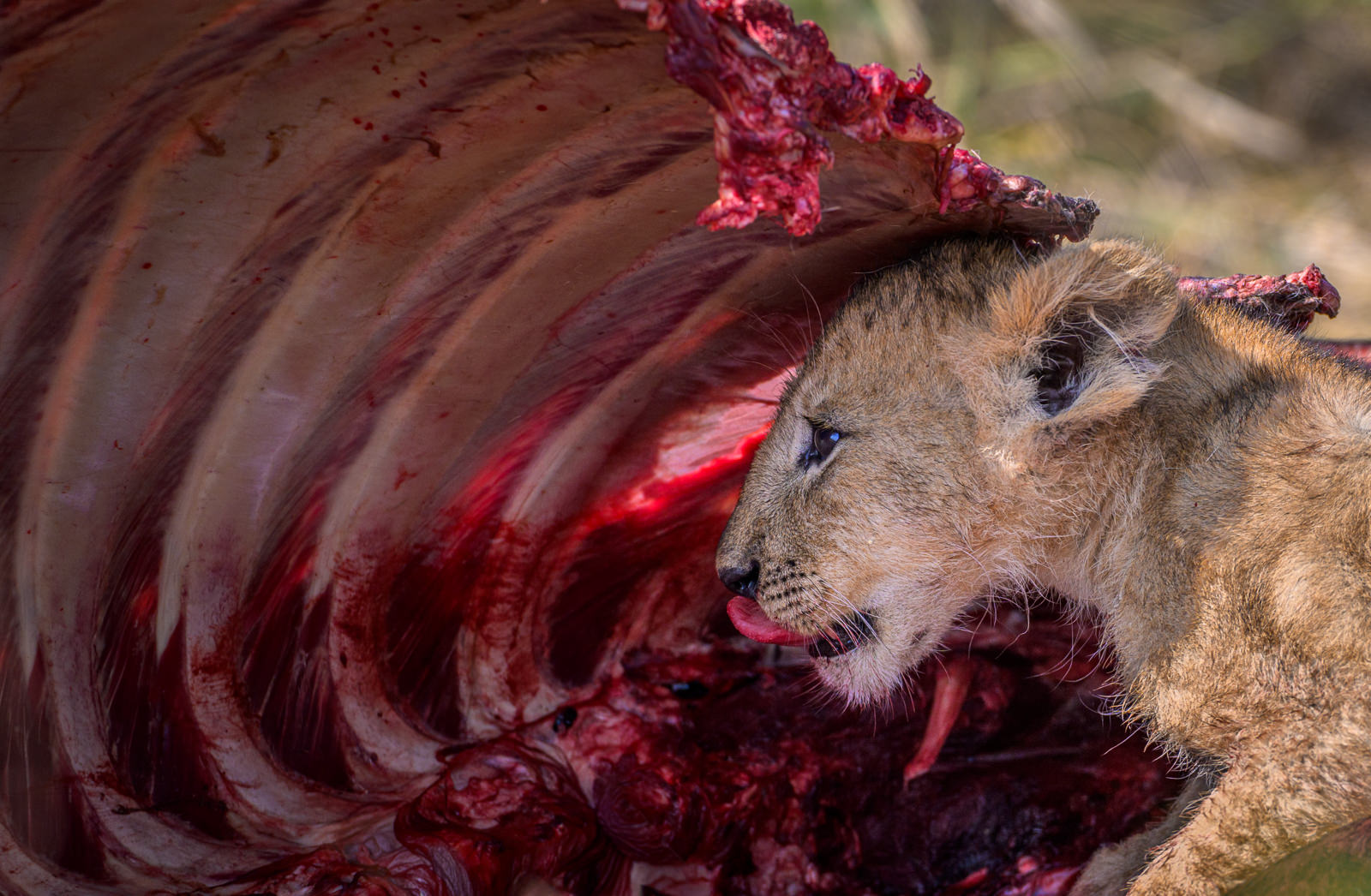
This one isn’t for everyone, so apologies for that. While in Kenya this summer we came across a pride of lions, including several young cubs, on a buffalo carcass. This particular cub was the boldest, getting right in there with the older lions. Eventually it crawled right inside the rib cage of the buffalo. Nikon Z8 with Nikkor 180-600mm lens (at 600mm) ISO 560, f/6.3 at 1/1000th of a second.
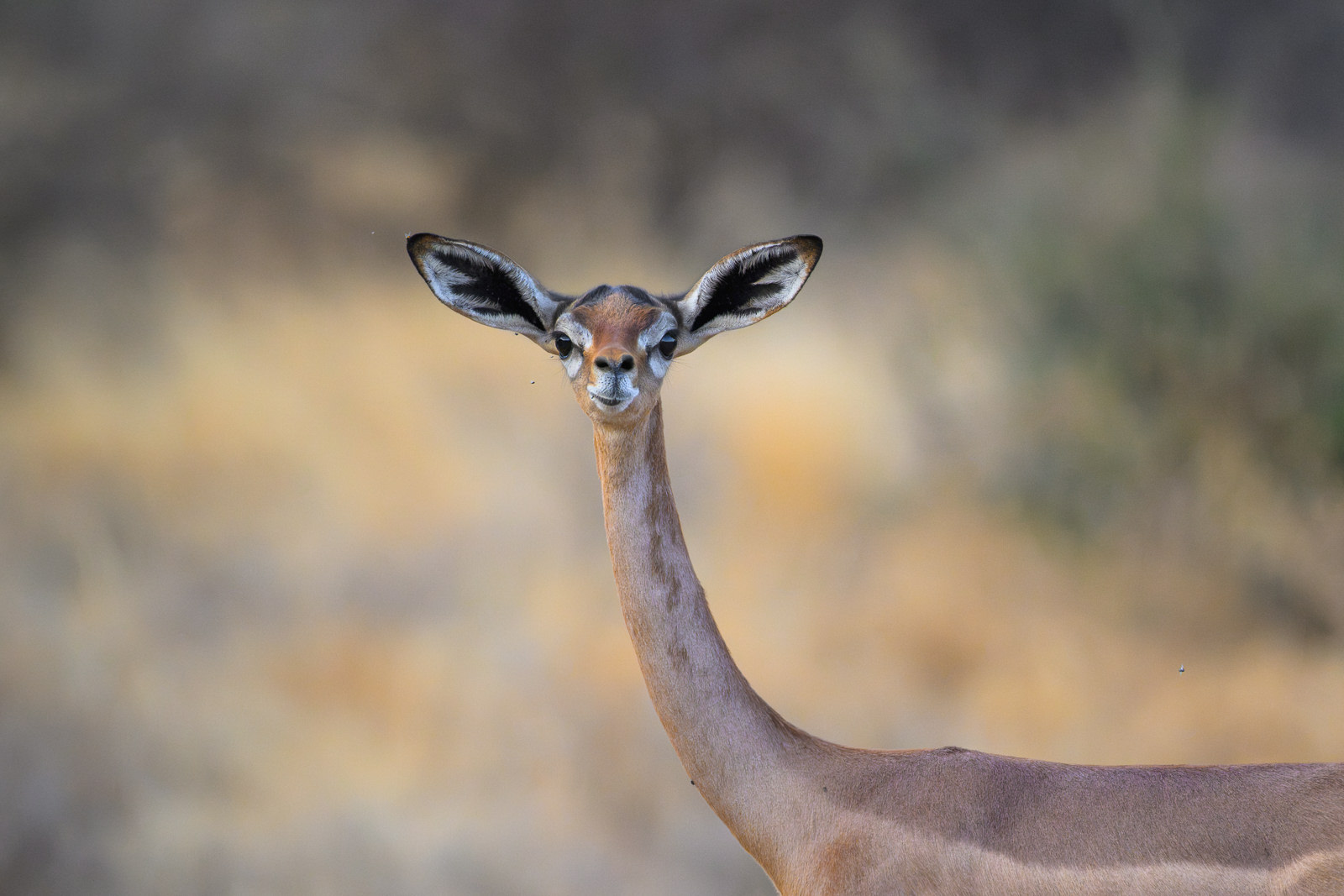
A female gerenuk’s neck isn’t any longer than a male’s, but because it’s much skinnier, it appears longer. This young lady gave us a nice portrait opportunity as we drove by on our August trip to Kenya this summer. Nikon Z8 with Nikkor 180-600mm lens (at 540mm) ISO 5000, f/6.3 at 1/2000th of a second.
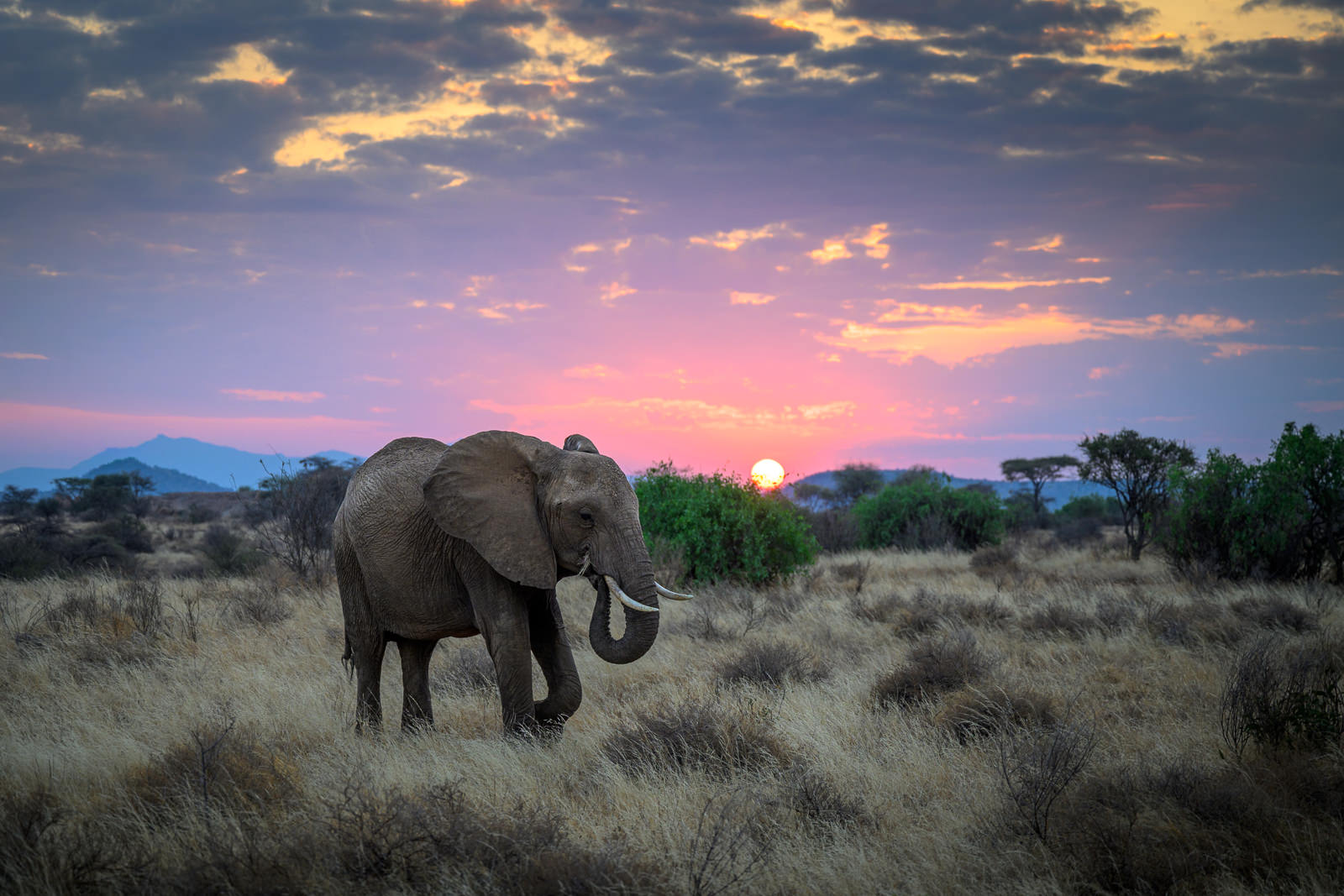
We generally get out before the sun comes up on our morning game drives. One of the many benefits is having time to find an iconic mammal of the savanna and position ourselves to capture it as the sun rises in the background. Nikon Z8 with Nikkor 24-70mm lens (at 70mm) ISO 200, f/2.8 at 1/250th of a second.
We use cookies to enhance your experience while using our website. If you are using our Services via a browser you can restrict, block or remove cookies through your web browser settings. We also use content and scripts from third parties that may use tracking technologies. You can selectively provide your consent below to allow such third party embeds. For complete information about the cookies we use, data we collect and how we process them, please check our Privacy Policy

 When speaking of humans, the term infant usually means up to one year old, but with mountain gorillas, an infant is classified as any individual up to there and half years old. After that they are classified as juveniles until the age of six. We saw this infant on our August trip to Uganda. He was playing on the ground only a few feet away when he suddenly started racing up that tree. Nikon Z8 with Nikkor 24-70mm lens (at 39mm) ISO 900, f/2.8 at 1/640th of a second.