Tayras are pretty cool creatures. They kind of look like otters that live in trees in the rainforest. Like otters, they are in the mustelid family. This tayra — photographed in the cloud forest of Ecuador — had the good fortune to stumble upon a big pile of bananas, giving me the chance to grab a few quick shots. Nikon D800 with Nikkor 200-400mm lens (at 400mm) ISO 3200, f/4 at 1/160th of a second
Coyotes have become pretty common these days thanks to their ability to adapt to so many different habitats and weather conditions. Always nice to see them in Yellowstone in the wintertime. This guy clearly had his eye on something as he burst through the snow. Nikon D700 with Nikkor 70-200mm lens (at 155mm) ISO 800, f/3.5 at 1/640th of a second
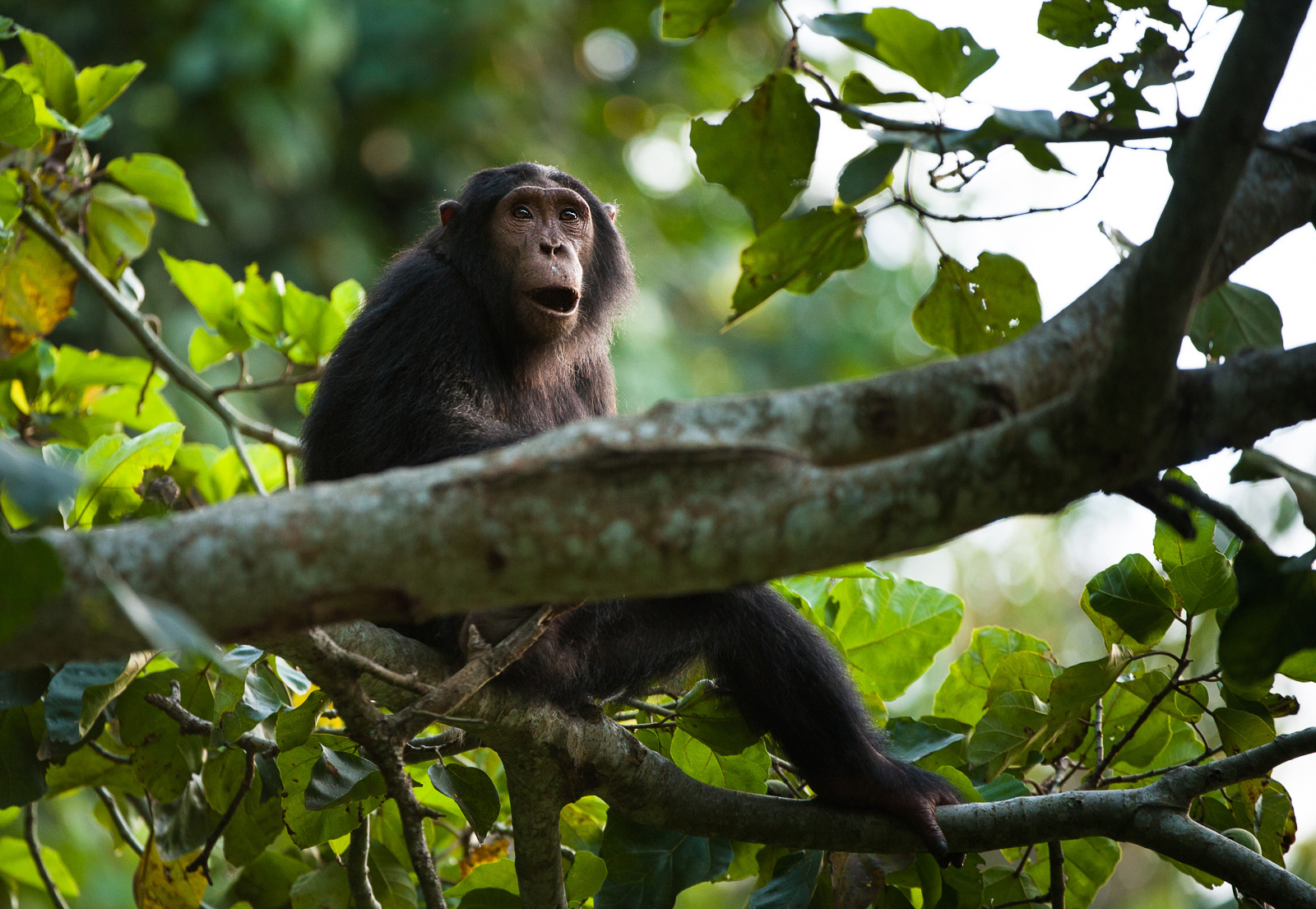
Chimps are actually pretty hard to photograph in the wild. They usually hang out high in the tree tops and are very active, ducking in and out of thick vegetation. I was lucky to encounter a troop at the end of the day in Queen Elizabeth National Park in Uganda, fairly low to the ground. I was able to get very close to this young lady and had just enough light before the sun disappeared. Nikon D700 with Nikkor 200-400mm lens (at 350mm) ISO 800, f/4 at 1/200th of a second
Last month I posted a wild burro at a distance, behind a bush of yellow flowers. Here’s a completely different angle. As I mentioned previously, these wild burros, or donkeys, or asses if you prefer, are the only wild herd in the United States on anything other than federal land. They roam free on the hillsides of Moreno Valley in California. Nikon D800 with Nikkor 200-400mm lens (at 350mm) ISO 400, f/4 at 1/2500th of a second
In addition to lemurs and chameleons, Madagascar is also a great place to photograph frogs. This guy’s scientific name is Heterixalus Betsileo. Not sure of the common name. I photographed him/her on a night walk through the forests around the town of Perinet in central Madagascar. I’ve mentioned that in lieu of a dedicated macro lens, I used to capture shots like this by screwing a close up filter to the end of my mid range zoom lens. This creates a very narrow depth of field so a high aperture is necessary to get good results. I also used two flash units positioned close the subject to fill in the shadow areas. Nikon D200 with Nikkor 80-200mm lens (at 165mm) with Canon 500D close up filter, ISO 100, f/22 at 1/60th of a second, two Nikon SB-600 flash units
This Tasmanian devil appears to be letting out a blood curdling scream, but in reality, he was just a bit sleepy and letting out a good yawn. I photographed devils both in the wild (at night as they are mostly nocturnal) and at a few of the many captive breeding centers around Tasmania. The countrywide captive breeding program is vital to the survival of the species as the deadly and highly contagious facial tumor disease is bringing the current wild populations to the brink of extinction. This particular devil was at a place called Devils@Cradle, a rehab and reintroduction sanctuary at the base of Cradle Mountain National Park.
Nikon D810 with Nikkor 200-400mm lens (at 200mm) ISO 2200, f/4 at 1/160th of a second
This is a long-tailed macaque mother with her baby, photographed last November in Thailand. It goes out to all the mothers, human and otherwise, especially my own mom, wishing you all a Happy Mother’s Day weekend. Nikon D500 with Nikkor 200-400mm lens (at 200mm) ISO 800, f/4 at 1/1000th of a second
This little lion cub was taking a bit of a rest upon the safe confines of Dad’s well-fed torso. This was from my visit to the Kalahari Desert in Botswana. I didn’t expect to see as many lions as I did in the Kalahari, but got lucky with a pride that had just finished devouring an oryx kill and then proceeded to make their way over to a water hole where they all had an after dinner drink. Nikon D300 with Nikkor 200-400mm lens (at 380mm) ISO 400, f/5.6 at 1/250th of a second
The light wasn’t great on this one, but I liked the outstretched wings of this Madagascar flying fox just after it came in to roost. Shouldn’t be a surprise from the picture, that flying foxes are actually bats — the largest in the world. They also go by the name of fruit bats. Their diet consists mostly of juice from fruits that they squeeze into their mouths. This one was part of a colony of about a hundred, roosting high in the trees of Berenty Reserve in the south of Madagascar. Nikon D200 with Nikkor 600mm 5.6 manual focus lens, ISO 400, f/8 at 1/125th of a second
This is a male long-tailed meadowlark that I photographed on Carcass Island in the Falkland Islands. The blurred out yellow in the background is the gorse flowers that were growing all over the island when I was there. The female long-tailed meadowlarks are less colorful in appearance than the males, but they excel in other areas, such as nest building. They construct their nests in the tall grass, close to the ground. This allows them to exit the nest by first descending to the ground and then walking six or so feet before taking to the air. They arrive back at their nests in the same manner — landing in the grass six feet out and then hoofing it the rest of the way. They do this so that would-be predators can’t find their nests. Nikon D800 with Nikkor 200-400mm lens (at 400mm) ISO 800, f/4.5 at 1/1000th of a second
We use cookies to enhance your experience while using our website. If you are using our Services via a browser you can restrict, block or remove cookies through your web browser settings. We also use content and scripts from third parties that may use tracking technologies. You can selectively provide your consent below to allow such third party embeds. For complete information about the cookies we use, data we collect and how we process them, please check our Privacy Policy