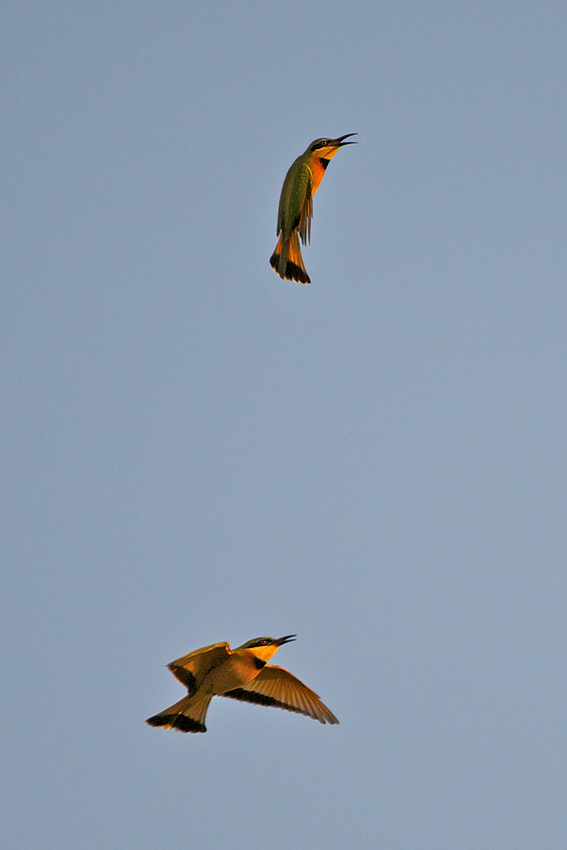
These guys are called little bee eaters. They are fairly common throughout sub Sahara Africa. As the name would suggest, they eat bees, and these two were doing just that as they darted through the air. Nikon D800 with Nikkor 200-400mm lens (at 400mm) ISO 400, f/4 at 1/1600th of a second
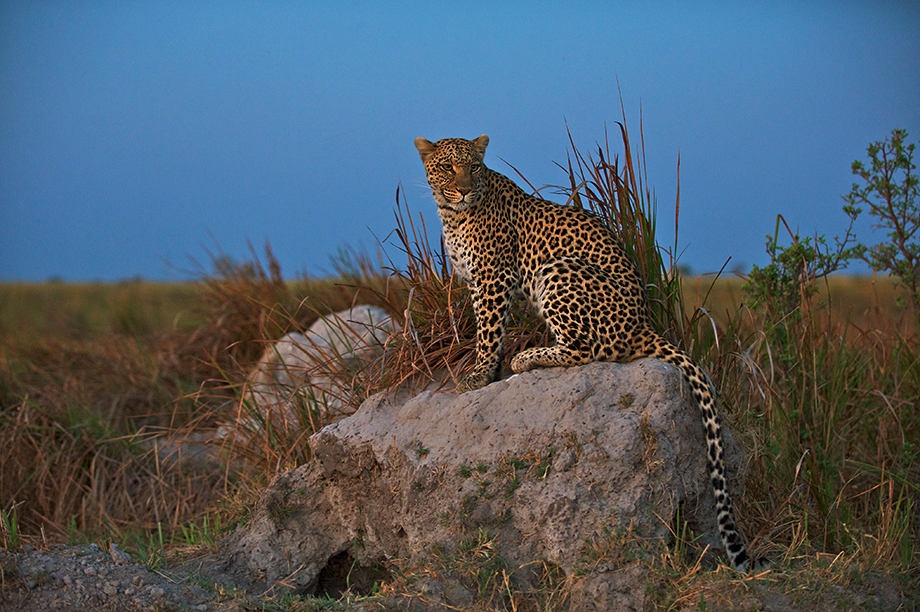
Twilight had just about ended and it was very dark when this leopard jumped up onto a termite mound and posed for a few portraits. Even at 3200 ISO, the files looked great coming out of my camera — showing very little noise, even at 100% crop. Nikon D700 with Nikkor 70-200mm lens (at 86mm) ISO 3200, f/2.8 at 1/25th of a second
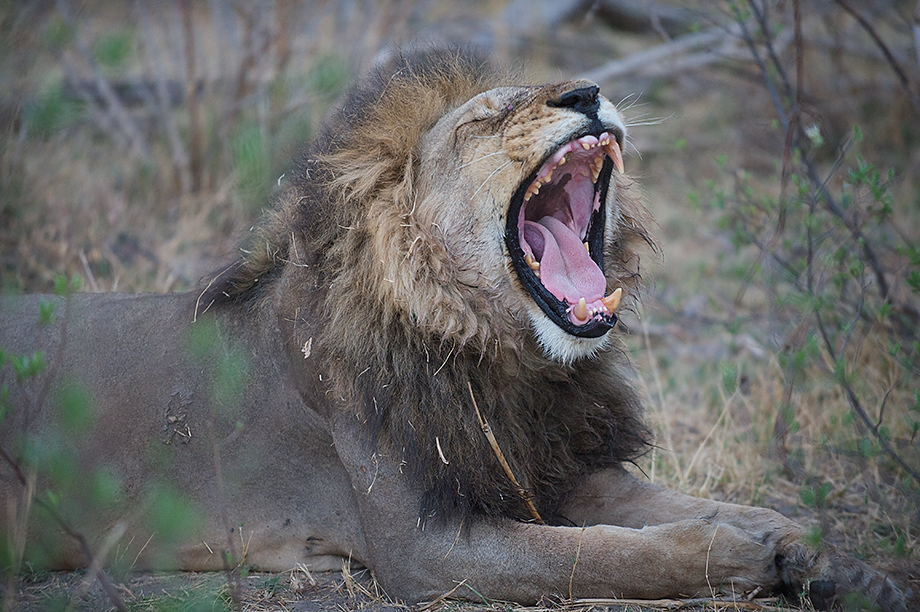
I really felt bad for this poor old boy. He was without a pride and trapped between the territories of two other prides. Apparently, he gets beat up a lot when he wanders too far north or south and into those other territories. Luckily, he did have a wildebeest kill when we came across him and he spent a couple of days near our camp feeding upon it. In this photo, he was letting out a big yawn before heading back to the kill. He was the only lion that we saw on the short Botswana trip. Nikon D700 with Nikkor 70-200mm lens (at 200mm) ISO 3200, f/2.8 at 1/100th of a second
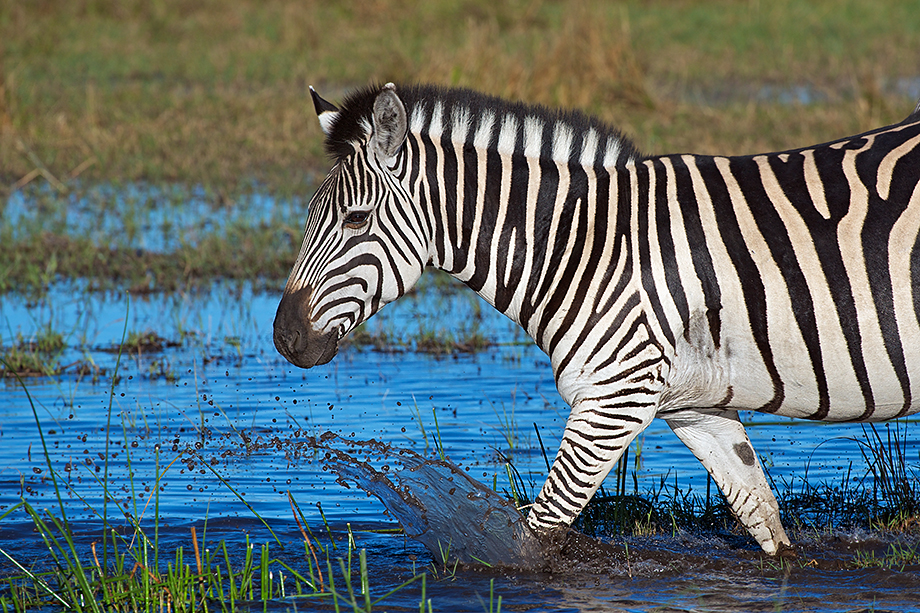
I’ll always remember my first trip to Africa back in 1999. I was amazed at how zebras didn’t get any respect. The guides thought that all tourists wanted to see were lions, leopards and elephants. Zebras were far too common to be of much interest. But I’ve always loved zebras — from that first trip in Tanzania to my last trip in Botswana. This one was part of a dazzle (yes, a group of zebras is, in fact, called a dazzle) crossing a river early in the afternoon. Nikon D800 with Nikkor 200-400mm lens (at 400mm) ISO 400, f/8 at 1/1250th of a second
The southern white faced owl is one of the three species of owl that we saw in our week in Botswana. This is a nocturnal owl, and it was asleep in a cavity of a dead tree when we came across it one afternoon. Some of you might know this guy from this very entertaining video that went viral a few years back and shows the owl’s amazing transformative abilities — Click Here.
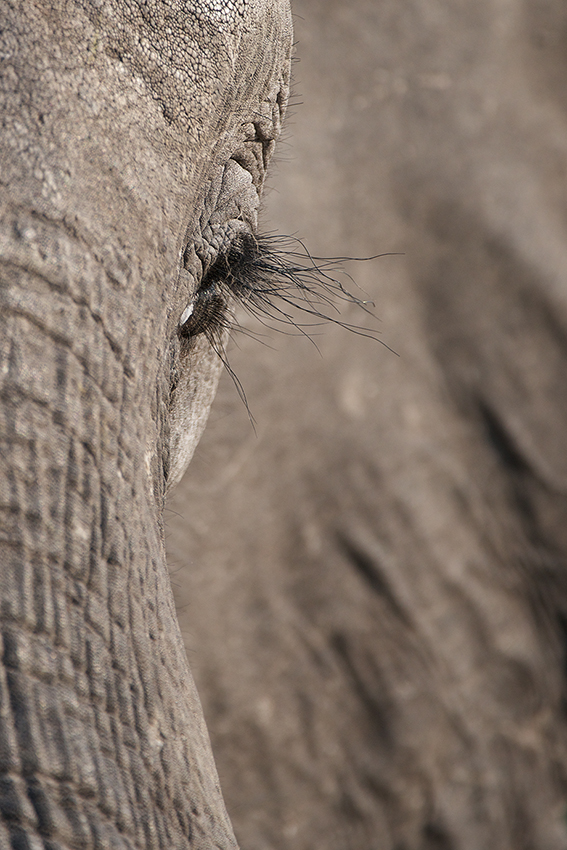
An elephant’s eyelashes can be quite long. They protect the eye from dust and also the sun. This guy was grazing very close to our vehicle allowing me to really zoom in on isolated areas of the face. Nikon D800 with Nikkor 200-400mm lens (at 400mm) ISO 400, f/4 at 1/1250th of a second
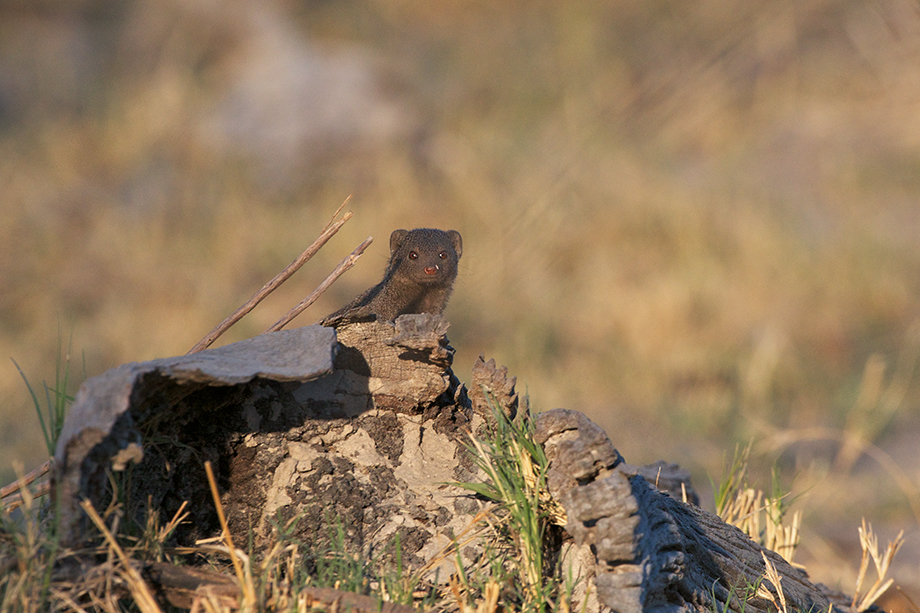
We saw three different species of mongoose on our Botswana trip. This is the smallest — aptly named the dwarf mongoose. In fact, the dwarf mongoose is the smallest carnivore in Africa. It preys on everything from insects, to scorpions, lizards, frogs, birds and rodents. Nikon D800 with Nikkor 200-400mm lens (at 400mm) ISO 800, f/6.3 at 1/500th of a second
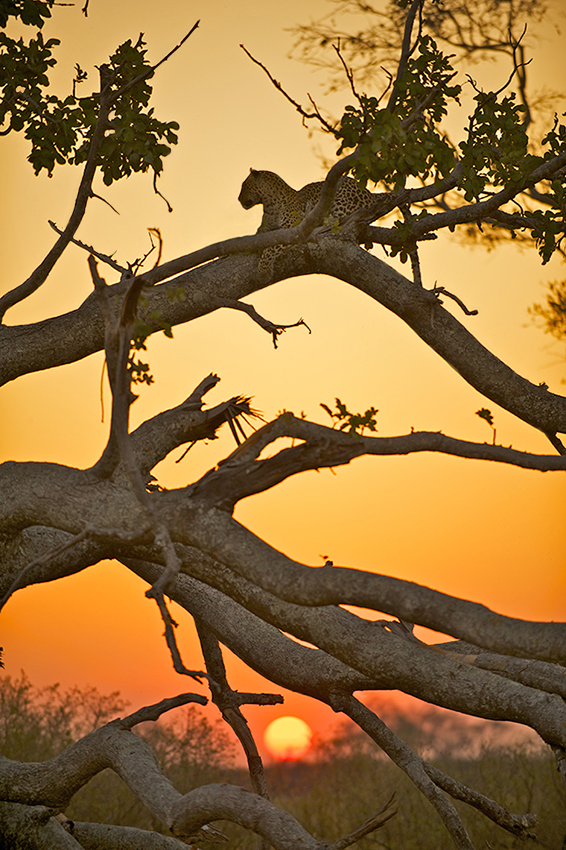
I know, a lot of leopards lately, but if I’m going to over post a species, why not the most attractive of all the African cats. This leopard was waiting for the sun to set before heading out on a nighttime hunt. I love when the horizon is hazy at sunset and the big orange sun is fairly weak, allowing me to capture detail in the foreground. Nikon D700 with Nikkor 70-200mm lens (at 190mm) ISO 400, f/2.8 at 1/640th of a second
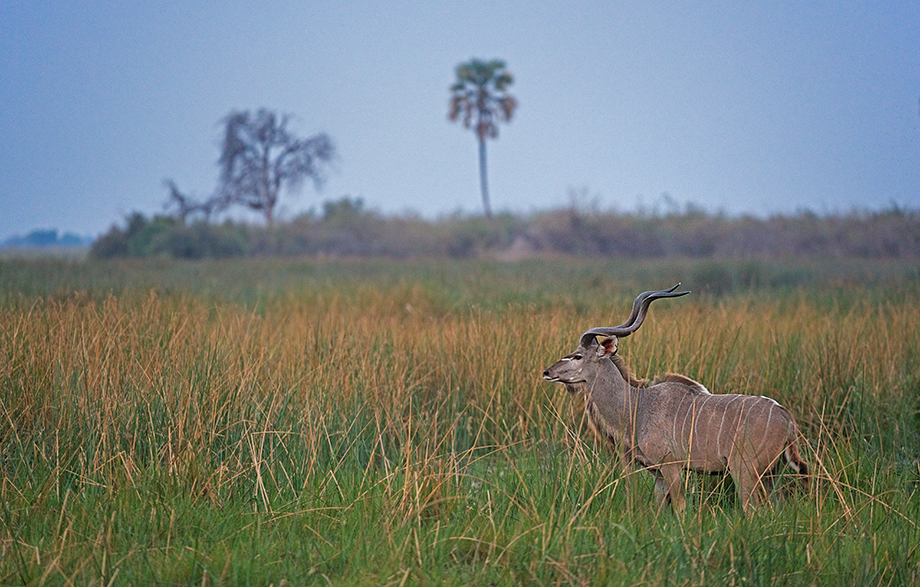
Kudu are just one of many species of African antelope we saw in Botswana. What sets them apart is their spectacular horns — at least in the male of the species — that spiral into the air, making two and half twists. The horns are often used as musical instruments in African culture. They are also used as musical instruments, or “shofars” in Jewish ceremonies, and at soccer tournaments. This guy was keeping a watchful eye out for a pack of wild dogs that were running around in the area. Nikon D800 with Nikkor 200-400mm lens (at 310mm) ISO 3200, f/4 at 1/160th of a second
I’m still waiting to hear about my eleven finalists in this year’s Nature’s Best/Smithsonian photo competition, but below are a few recent winners in other contests. Most you’ve probably seen before, but perhaps a few you haven’t.
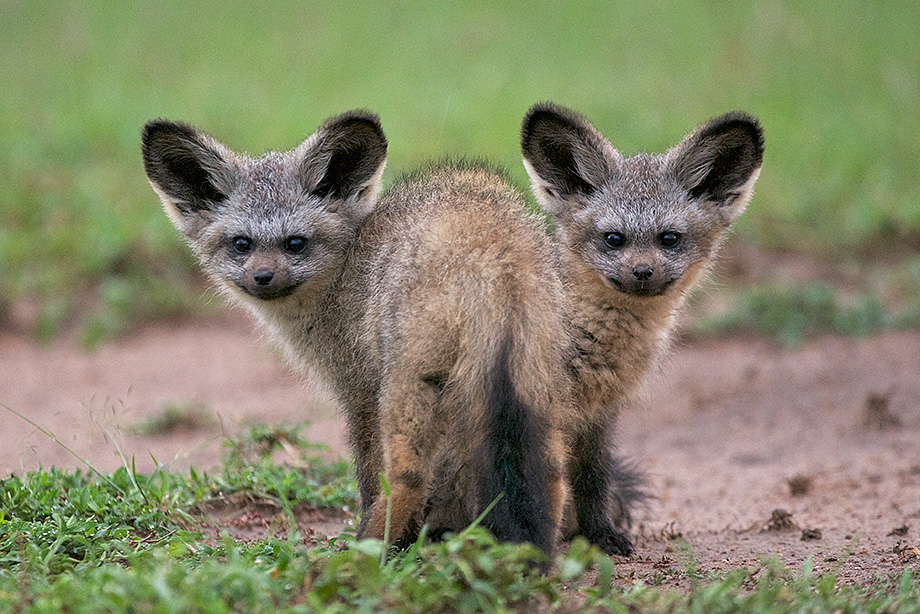
The above image of bat eared fox pups that appear to share one furry body continues to do well for me. It will appear in the 2013 Africa Geographic Calendar and it also just placed in the National Wildlife Federation photo contest. Still not sure of where it placed — I’ll know come November.
The above two images placed in the top 100 in this year’s North American Nature Photographers Association (NANPA) Showcase Competition.
And the above three placed in the top 250 in the NANPA Competition.
We use cookies to enhance your experience while using our website. If you are using our Services via a browser you can restrict, block or remove cookies through your web browser settings. We also use content and scripts from third parties that may use tracking technologies. You can selectively provide your consent below to allow such third party embeds. For complete information about the cookies we use, data we collect and how we process them, please check our Privacy Policy